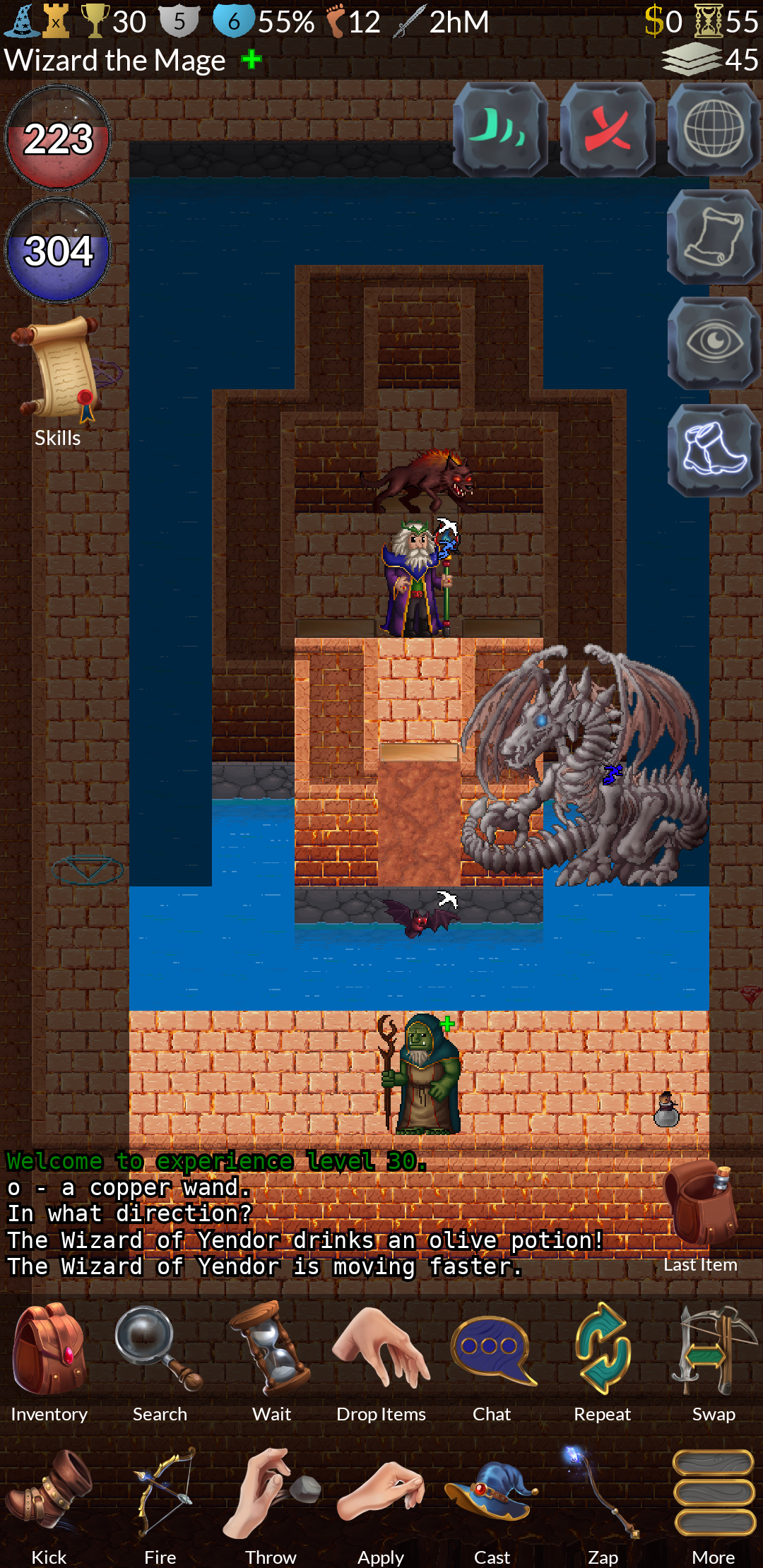
Android Screenshot
Features
- Several dungeon tilesets — Supports up to 16 tilesets for differents parts of the dungeon, including dedicated tilesets for Gnomish Mines, Valley of the Dead, and Gehennom.
- Tile layers — Several layers (background, items, monsters, effects) drawable at the same square.
- Enlarged tiles — Monsters, dungeon features (such as trees), and items (e.g., statues of large monsters) spanning overs multiple squares.
- Hidden monster transparency — Monsters hidden behind enlarged tiles are displayed transparently.
- Dynamic tile update — Tiles can be updated based on underlying item or monster statistics (such as chest being locked or not). There are also automatic drawing routines for more complicated operations, such as generating endings for walls and drawing weapon rack contents.
- New outdoor tiles — Grass and ground to make outdoor maps look better.
- Tile variations — Each dungeon ("cmap") tile can have variations, such as dedicated tiles for differently aligned altars.
- Condition graphics — Small graphics drawn on the top of the player and monsters for various statuses, conditions, and buffs.
- Player character graphics — Dedicated graphics for all player character types.
- Female monster graphics — Dedicated graphics for various female monsters.
- Missile graphics — Thrown and fired missile tiles are rotated to face the correct direction.
- Artifact graphics — Dedicated graphics for all artifacts.
- Special effects — Special effect graphics for spells, summoning, and teleportation.
- Linked tile drawing — Dedicated drawing system for linked tiles such as leash between the player and the leashed monster. Also, support for drawing tethered aklys, a chain for iron ball, and a long worm.