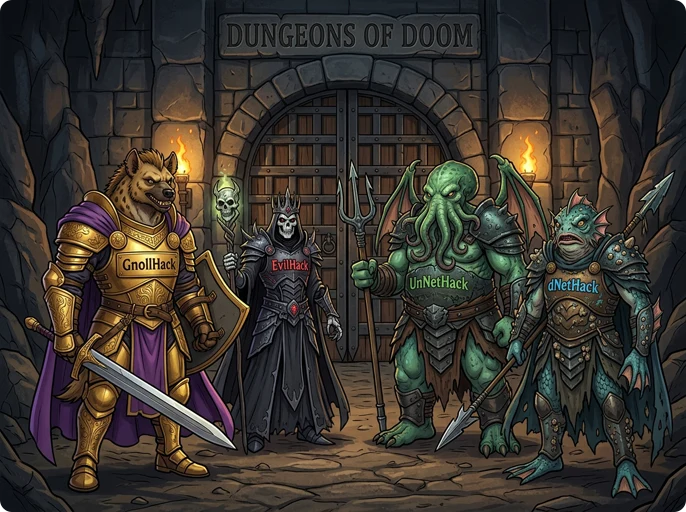
👉 NetHack is a classic, famously challenging roguelike game. While GnollHack is designed as an approachable entry point for beginners and modern gamers to experience the genre, other popular versions (known as variants) like EvilHack, UnNetHack, and dNetHack target veteran players seeking even greater complexity. This document compares their differing design philosophies.
Target Audiences
The variants differ significantly in who they are built for:
- GnollHack: Designed for beginners and modern gamers.
- EvilHack, UnNetHack, and dNetHack: Targeted at experienced NetHack veterans.
1. Difficulty Philosophy
The primary difference lies in how these variants structure their difficulty curves and approach new players.
- GnollHack: Features 7 selectable difficulty levels and non-permadeath modes (such as Casual Mode and Modern Mode) specifically designed for players learning the game. The early-game mechanics are tuned to be more forgiving by providing players with stronger starting equipment and smoothing out high-variance, lethal encounters. This creates a welcoming environment for newcomers who might find traditional roguelikes intimidating.
- EvilHack, UnNetHack, and dNetHack: These variants are explicitly designed to offer a significantly more difficult and challenging experience than vanilla NetHack. They introduce complex new mechanics, smarter enemies, and high-lethality situations that test the skills of players who have already mastered the base game. They do not include casual modes or specific beginner-friendly difficulty settings.
2. Interface and Input Methods
The variants take fundamentally different approaches to visual presentation and player input, which directly impacts their accessibility.
- GnollHack: Built for mobile and desktop devices with a native, modern UI. Inventory management utilizes a tap-based (or click-based), visual menu system. Interacting with an item brings up a clear, context-sensitive menu (e.g., "Wield," "Put On"), and common actions are accessible via an on-screen command bar. It replaces the classic ASCII display with animated high-resolution tiles, a full soundtrack, and professional voice acting to appeal to modern gaming preferences.
- EvilHack, UnNetHack, and dNetHack: These variants primarily utilize the traditional terminal-based ASCII interface or basic, static 2D tilesets, maintaining the classic NetHack visual presentation. They rely on the traditional keyboard command structure, which requires memorizing a vast array of keystrokes—a system preferred by veterans but often seen as a steep learning curve for modern gamers.
3. Loot Systems and Simulation Mechanics
- GnollHack: Introduces an ARPG-style loot system with randomized prefixes and suffixes and damage-boosting weapon quality modifiers, such as exceptional and elite. It adds new equipment slots, such as Robe, Bracers, and Miscellaneous Items, so players have a vastly increased number of viable equipment setups. It also expands the utility of gold, allowing players to pay NPCs to, for example, identify unknown items.
- EvilHack, UnNetHack, and dNetHack: These variants introduce complex mechanics that require deeper system knowledge. They might introduce object materials with specific vulnerabilities, replace standard survival mechanics with intricate new systems to ensure veteran players cannot rely on memorized strategies.
Summary
Ultimately, GnollHack focuses on approachability, modernizing the UI, and providing a structured learning curve for players who are new to traditional roguelikes.
Variants like EvilHack, UnNetHack, and dNetHack focus on expanding the depth, lethality, and mechanical complexity of the original game to test the mastery of players who have already completed vanilla NetHack.